Updated 30 September 2026 · Prices checked August 2026
A well water test package costs $40 to $220, and the standard annual test from an accredited university laboratory runs about $60, or about $70 with nitrate added. A single coliform bacteria test on its own is roughly $40. Broader packages that add metals cost $125 to $220. Many county health departments run the basic bacteria and nitrate panel free or at a subsidized price, so call the county before paying anyone.
A well water test costs $40 to $220 depending on the package, and the standard annual test runs $60, which is less than most owners expect. The reason owners overpay is almost always the same: they buy a broad panel when a narrow one would answer the question, or they buy a narrow one twice because the first sample did not include the test that mattered. The Centers for Disease Control and Prevention recommends an annual test for coliform bacteria, nitrate, total dissolved solids and pH, and that annual baseline is the cheapest part of owning a well.
Prices vary by laboratory and by state, so this guide uses published price lists from accredited laboratories rather than averages. Penn State’s Agricultural Analytical Services Laboratory publishes its full schedule, and the numbers below are taken from it and from a county extension price list, both checked in August 2026. Treat them as a realistic reference point, not a quote for your area.
What Well Water Testing Actually Costs
The table below uses published prices from accredited laboratories. Package names differ between laboratories, but the tiers are consistent everywhere: a cheap bacteriological baseline, a mid-priced package that adds the minerals affecting taste and plumbing, and an expensive panel that adds trace metals.
| Test or package | What it covers | Published price | Source of the price |
|---|---|---|---|
| Standard annual package | Total coliform, E. coli, pH, total dissolved solids | $60.00 | Penn State AASL (WD01) |
| Agriculture / septic package | Standard package plus nitrate-nitrogen | $70.00 | Penn State AASL (WD04) |
| Coliform and E. coli only | Bacteria alone, the single cheapest meaningful test | $40.00 | Penn State AASL and UGA Extension |
| Aesthetics / corrosivity | Standard plus hardness, alkalinity, corrosivity index, copper, iron, manganese | $85.00 | Penn State AASL (WD02) |
| Real-estate closing panel | Lead, nitrate, nitrite, total coliform, E. coli | $90.00 | UGA Extension, Cobb County |
| Aesthetics plus lead | Aesthetics package plus first-draw and running lead and copper | $125.00 | Penn State AASL (WD03) |
| Expanded chemical panel | Broader chemical panel including lead and arsenic | $125.00 | UGA Extension, Cobb County |
| Trace metals package | Standard plus arsenic, barium, cadmium, chromium, copper, lead, nickel, zinc | $130.00 | Penn State AASL (WD07) |
| Extensive panel | Comprehensive bacteria, pH, metals, minerals and nutrients | $220.00 | Penn State AASL (WD08) |
| Nitrate-nitrogen alone | Single analyte, useful as a follow-up retest | $15.00 | Penn State AASL |
| Arsenic alone | Single analyte, worth doing once on bedrock wells | $30.00 | Penn State AASL |
| Lead alone | Single analyte, sampled first-draw | $25.00 | Penn State AASL |
| Iron or manganese alone | Single analyte, for staining complaints | $15.00 | Penn State AASL |
| Hardness alone | Single analyte, needed to size a softener | $20.00 | Penn State AASL |
| County health department panel | Commonly bacteria and nitrate, sometimes arsenic, lead and manganese | Free to low cost | Varies by county and state program |
Prices are those published by the named laboratories and were checked in August 2026. Laboratory schedules change, and shipping, sample kits and rush handling are usually charged separately.
Every figure in the table above is a published list price from a named accredited laboratory or extension service, not an industry estimate or an average of quotes.
Sources: Penn State Agricultural Analytical Services Laboratory drinking water schedule; University of Georgia Cooperative Extension, Cobb County water testing prices. Both checked August 2026.
The Four Places You Can Buy a Test, and What Each Is Good For
The same sample analyzed by four different providers produces four different prices, and the cheapest is not always the right choice.
- Your county health department. Often free or heavily subsidized for the bacteria and nitrate baseline, sometimes with seasonal collection clinics. Several state programs fund free testing for specific counties, including arsenic, lead and manganese. The limitation is scope: the free panel rarely covers metals, and turnaround depends on the program.
- A university or state accredited laboratory. Published price lists, accredited methods, and staff who will explain a result. This is the best value for annual testing and the tier the table above is built on.
- A national mail-in laboratory. Convenient, with consumer-friendly reports and wide panels. Prices sit higher than university laboratories for equivalent analyte counts, and the broadest consumer panels are usually more testing than a first-time owner needs.
- A local commercial laboratory. Useful when you need a fast turnaround, a specific regulated method, or a result that a lender or health department will accept for a property transaction.
Whichever tier you use, the laboratory must be accredited by your state for drinking water. An unaccredited result is not accepted for a real-estate closing or a health department follow-up, and paying twice for the same analysis is the most common way well owners waste money on testing.
What Changes the Price
Four factors move the number, and understanding them is what turns a $220 panel into a $70 one without losing anything you needed.
The number of analytes. This is the dominant factor. Bacteria and a handful of field parameters are cheap. Every metal added to a panel requires instrument time, which is why trace metal packages cost twice a standard one.
The method required. Some analytes have a cheap screening method and an expensive confirmatory one. Gross alpha is a screen; identifying which radionuclide is responsible costs more. PFAS is the extreme case, because the required methods are expensive and the reporting limits have to be low enough to be useful.
Whether the result has to stand up. A result used for a mortgage, an insurance claim or a regulatory submission carries chain-of-custody handling and documentation, and that costs more than the same analysis run for your own information.
Turnaround. Rush handling is a surcharge at every laboratory. Bacteria samples also have a holding time, usually 24 to 30 hours, so a sample that misses the courier has to be recollected, which is a cost that does not appear on any price list.
Home Test Kits Versus Laboratory Testing
Home strip kits sell for a few dollars and have one legitimate use: tracking something you already know about, between laboratory tests. A strip will tell you your softener has stopped removing hardness, or that iron has risen since spring. It will not give you a number you can act on for a health contaminant.
Strips do not have the sensitivity required for arsenic at 0.010 mg/L or nitrate at 10 mg/L with the precision those limits demand, and no home kit produces a coliform result that a health department will accept. The reasonable pattern is a certified laboratory test annually, with strips used in between for the nuisance parameters you are actively managing.
Never rely on a home strip kit to clear water for an infant, after a flood, or following a coliform positive. Those three situations need an accredited laboratory result, and in the meantime bottled water is the correct answer rather than a strip that reads acceptable.
Matching What You Spend to Your Situation
Most owners need one of four spending patterns, and recognizing which one you are in prevents both overspending and the more expensive mistake of testing too narrowly.
If you are testing routinely with no symptoms and no known local issue, buy the standard package with nitrate added, at roughly $70, once a year. If you have just bought the property or have never tested, add a one-time trace metals panel at around $130, because bedrock chemistry is stable and that result stays useful for years.
If you have a specific symptom, buy the single analyte rather than a package. Orange staining is an iron test at $15, not a $220 panel. If a lender, a buyer or a health department is involved, buy the panel they specify from a laboratory they accept, because a cheaper test that gets rejected costs the full price twice.
A well owner with no symptoms who tests annually should expect to spend roughly $60 to $70 a year, plus about $130 once in the first year for the metals baseline. Spending more than that every year usually means buying breadth that is not answering a question.
How to Avoid Paying for the Same Test Twice
Decide what you are testing for before you order, using where your well sits rather than a catalogue. Our well water contaminants reference lists which contaminants are worth testing for routinely and which depend on local geology, agriculture or industry, so the panel you buy answers the question you actually have.
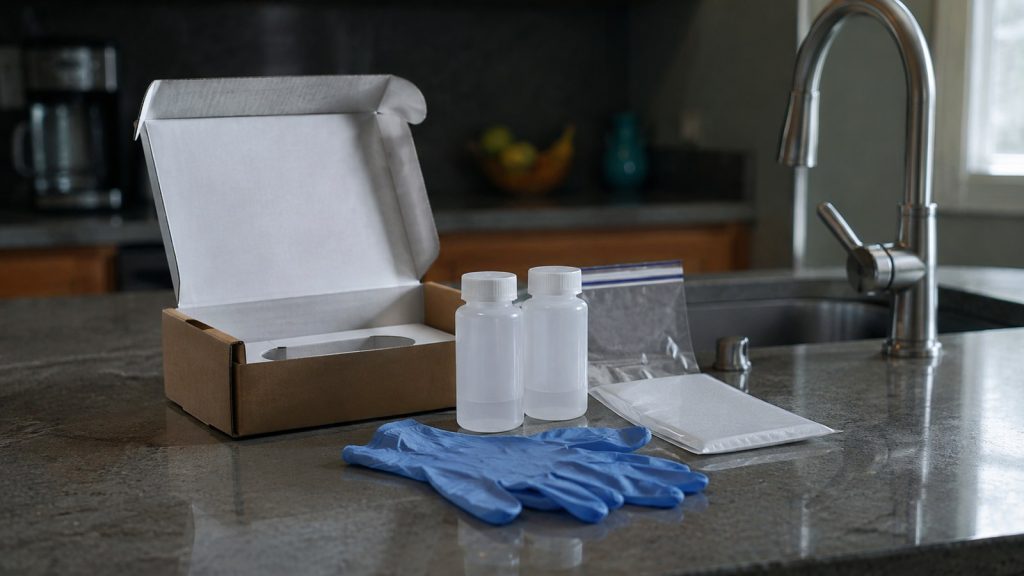
Then collect the sample properly. Follow the laboratory’s instructions exactly, use the bottles it supplies, and get the sample back within the stated holding time. A carefully chosen panel collected badly is money spent on a number you cannot trust, and bacteria results are the most sensitive to sampling technique of anything on the price list.
Frequently Asked Questions (FAQs)
How much does a basic well water test cost?
About $60 for a standard package covering total coliform, E. coli, pH and total dissolved solids at an accredited university laboratory, or about $70 with nitrate added. A coliform and E. coli test on its own is roughly $40. Many county health departments run the same basic panel free or at a subsidized price.
Is free well water testing available?
In many places, yes. County health departments frequently fund bacteria and nitrate testing for private wells, and some state programs fund broader panels including arsenic, lead and manganese for specific counties. Call your county environmental health office first, because the free panel often covers exactly the contaminants the annual baseline calls for.
Why is a full panel so much more expensive than a basic one?
Because price tracks the number of analytes and the instrument time each one needs. Bacteria and field parameters are quick. Each trace metal requires separate instrument work, which is why a trace metals package runs about $130 against $60 for the standard one.
Are home water test kits worth buying?
For tracking a known nuisance problem between laboratory tests, yes. For deciding whether your water is safe, no. Strips lack the sensitivity that health limits require, and no home kit gives a coliform result a health department will accept.
How often do I have to pay for testing?
Annually for the bacteria and nitrate baseline. Metals and radionuclides come from bedrock and change slowly, so a single test every three to five years is usually enough unless something nearby changes. Retest immediately after flooding, well work, or any change in taste, smell or appearance, regardless of when the last test was.
- Penn State Agricultural Analytical Services Laboratory, drinking water test packages and individual analyte prices, checked August 2026.
- University of Georgia Cooperative Extension, Cobb County, water testing prices, checked August 2026.
- CDC, Guidelines for Testing Well Water, annual testing recommendations.
- Minnesota Department of Health, private well testing programs including funded county testing.



