Updated 30 September 2026
A UV water purifier for well water uses germicidal ultraviolet light to disable bacteria and viruses as water passes through a chamber, without adding chemicals. It needs a sediment pre-filter ahead of it, an annual bulb change, and correct sizing to the home’s flow rate in gallons per minute. It does not remove sediment, chemicals, or dissolved minerals, so it typically sits at the end of a treatment train, not the start.
UV light bulbs used in water treatment lose intensity gradually and need replacement about once a year, according to Penn State Extension, which also notes the systems typically add only $2 to $4 a month to an electric bill. That single maintenance step, done on schedule, is what separates a UV water purifier that actually protects a well from one that looks like it is running while the bulb has quietly gone dark.
Treatment always starts with a decision about method. The CDC groups well water treatment into filtering, distilling, or disinfecting, and notes that no single method protects against every contaminant. UV is a disinfecting technology built for one job: neutralizing bacteria and viruses with light, not filtering anything out of the water physically.
The challenge most homeowners hit is treating UV as a stand-alone fix. A UV unit installed without pre-filtration lets sediment shield bacteria from the light, and a unit sized below the home’s peak flow rate lets water pass through too fast for the dose to work, both of which produce water that looks treated but is not reliably disinfected.
How UV Disinfection Actually Works
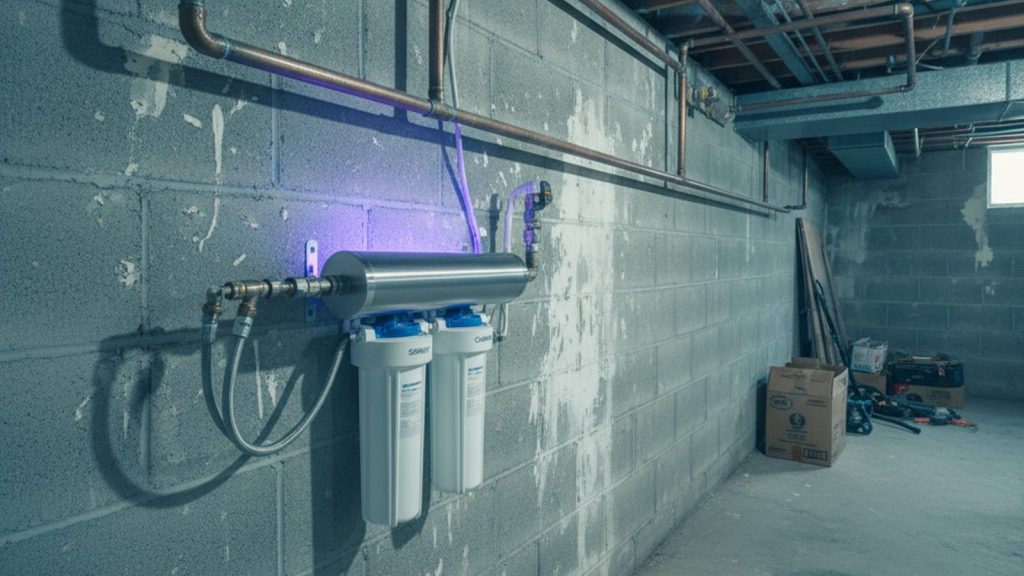
Water flows through a stainless steel chamber past a UV-C lamp, and the light energy damages the DNA of bacteria, viruses, and protozoa as they pass, disabling their ability to reproduce and cause illness. Nothing is added to the water and nothing is physically filtered out, which is why UV pairs with, rather than replaces, sediment and carbon stages.
This guide sits in our Filtration & Treatment section alongside the coliform bacteria guide and the full treatment overview.
Penn State Extension notes that UV units are not recommended for water where total coliform bacteria exceed 1,000 colonies per 100 milliliters, or fecal coliform exceeds 100 colonies per 100 milliliters. Water testing above those levels needs shock chlorination first, with UV added afterward for ongoing disinfection rather than as the initial fix.
Penn State Extension states that a UV system kills bacteria only inside the unit itself and provides no residual disinfectant for organisms surviving downstream or entering the plumbing after the light, unlike chlorination, which leaves a protective residual through the pipes.
The Non-Negotiables: Pre-Filter and Annual Bulb
A sediment pre-filter, typically rated 5 to 10 microns, is installed directly ahead of every UV unit. Sediment in the water scatters and blocks UV light before it reaches organisms passing through, cutting the water’s UV transmittance, and a quartz sleeve fouled by mineral buildup or grit cuts dose delivery even when the bulb itself is working.
The bulb itself loses UV-C output well before it visibly goes dark, which is why replacement runs on a calendar, about once a year, rather than waiting for a failure a homeowner can see or smell. Most systems include an hour-meter or indicator light specifically because bulb degradation is otherwise invisible.
Sizing a UV System to Flow Rate
| System size | Flow rate | Typical use | Bulb cost/yr |
|---|---|---|---|
| Compact (e.g. Viqua VH150) | 5 GPM | Small home, 1-3 bathrooms | $130-170 |
| Standard (e.g. Viqua VH200) | 9 GPM | Typical single-family home | $135-166 |
| High-flow (e.g. Viqua VH410) | 14 GPM | Large home, light commercial | ~$155 |
Sizing below the home’s peak demand, several fixtures running at once, reduces contact time inside the chamber and can push disinfection below the dose the unit is rated to deliver. Sizing to peak GPM rather than average household use is the detail that keeps a correctly chosen unit performing the way its rating promises.
After installing any disinfection stage, confirming it is working belongs on a schedule of its own. Our how often to test well water guide covers the retest interval for a system like this.
Dose is measured in millijoules per square centimeter, and most residential systems are built to deliver a standard dose at their rated flow rate, not above it. Running a 9 GPM unit at 12 GPM during a peak-demand moment, several fixtures open at once, spreads the same light output over more water and thins the dose below the level the system was validated to deliver.
Will a UV Filter Remove Iron, Hardness, or Chemicals?
UV neutralizes living organisms; it does nothing to sediment, iron, hardness minerals, nitrate, arsenic, or chemical contaminants already in the water. A well testing high for iron or heavy sediment still needs those stages installed, since untreated iron and grit both interfere with UV performance in addition to causing their own separate problems.
Those dissolved chemical contaminants need a separate stage entirely. Our reverse osmosis guide covers what RO removes that UV cannot touch.
UV also leaves no residual protection. Chlorination keeps working as water sits in pipes; UV only treats water at the moment it passes through the chamber, so any recontamination downstream, a cracked pipe joint or an open storage tank, is not covered by a UV unit already installed upstream.
A whole-house UV unit is standard placement, installed at the point where water enters the home after sediment filtration and before the water heater, so every fixture receives treated water. A point-of-use UV unit under a single sink protects drinking water at that tap but leaves showers, laundry, and every other fixture on untreated supply, which matters for a well with confirmed bacterial contamination throughout the system.
The Challenges of Running UV on a Well
The first challenge is upstream sediment. A well that runs even mildly cloudy needs a pre-filter dialed in before UV is trusted for anything, since scattered light through cloudy water lets organisms pass through the chamber undertreated.
The second challenge is the invisible maintenance schedule. A bulb past its rated life keeps the unit running and the indicator light on in some models, while UV-C output has already dropped below an effective dose, which is why the annual replacement has to happen on a calendar rather than on visible failure.
The third challenge is power dependency. A UV system stops disinfecting the moment power is lost, and a well relying on it exclusively during an outage should treat that water as unsafe until power and UV output are both confirmed restored.
If a test shows total coliform above 1,000 colonies per 100 mL or fecal coliform above 100 colonies per 100 mL, do not rely on UV alone. Shock chlorinate the well first and retest clean before treating UV as the ongoing disinfection method.
How to Decide if UV Is Right for Your Well
Start with a bacteria test, not an assumption. UV fits wells with confirmed coliform contamination at moderate levels and no other unaddressed sediment or iron problem upstream. Compare it against the coliform basics in the coliform bacteria in well water guide before deciding whether UV, chlorination, or both are the right combination for a specific test result.
Once sediment and any other contaminants are under control, size the UV unit to peak flow rate rather than average use, and put the annual bulb change on a fixed calendar reminder rather than waiting for a visible sign the water has changed.
Frequently Asked Questions (FAQs)
How does UV water purification work?
Water passes through a chamber past a UV-C lamp, and the light damages the DNA of bacteria, viruses, and protozoa, disabling their ability to reproduce and cause illness. No chemicals are added and nothing is physically filtered out of the water.
Does UV remove bacteria from well water?
UV neutralizes bacteria rather than removing them physically, disabling their ability to cause illness as they pass through the chamber. It works only within the unit itself and provides no residual protection for water sitting in pipes afterward.
How often do UV bulbs need to be replaced?
About once a year. UV-C output drops well before a bulb visibly fails, which is why replacement runs on a calendar rather than waiting for a sign a homeowner can see or smell.
Do I need pre-filtration with a UV system?
Yes. A sediment pre-filter, typically rated 5 to 10 microns, stops particles from scattering or blocking UV light before it reaches organisms passing through the chamber. Skipping it lets sediment shield bacteria from the dose the unit is rated to deliver.
Can a UV system replace a water softener or iron filter?
No. UV only addresses bacteria and viruses. Hardness, iron, sediment, and dissolved chemicals all need their own dedicated treatment stage, since UV light has no effect on minerals or particles already present in the water.



