Updated 30 September 2026
Well water treatment is built in a sequence, not a single box: sediment filtration first, then oxidation or ion exchange for iron and manganese, a softener for hardness, disinfection for bacteria, and reverse osmosis or carbon filtration last for taste and remaining chemicals. The right combination depends entirely on what your lab report shows.
No single product fixes every well. The CDC states plainly that no single treatment type protects against every problem, and choosing the right one means matching it to what your specific water needs. That guidance runs against how most treatment systems get sold: one product, marketed as the universal answer.
Testing has to come first regardless of which system eventually gets installed. The EPA recommends testing your private well annually for total coliform bacteria, nitrates, total dissolved solids, and pH, the baseline data any well water treatment decision should start from. Buying equipment before that report is in hand means guessing at a problem instead of solving one.
Most wells don’t have one contaminant. They have a combination, iron and hardness, sulfur and sediment, bacteria and low pH, and the right treatment train depends on which combination you’re actually facing, not on which single product a salesperson is pushing that week.
How to Build a Well Water Filter System Around What Your Test Found
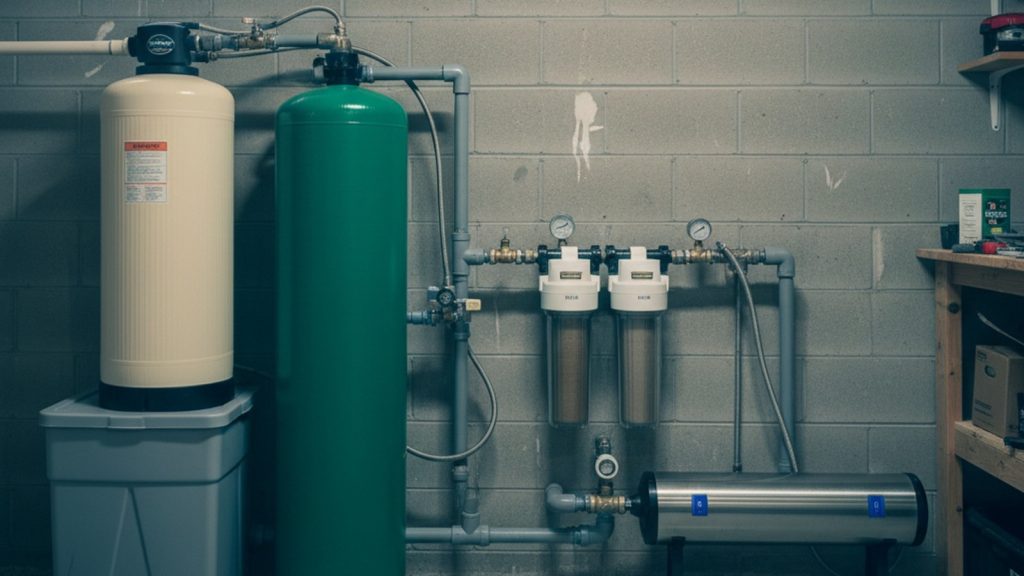
A treatment train is the order equipment gets installed in, since each stage protects the one after it. Sediment goes first because it clogs and damages every downstream component. Oxidation or a softener goes in the middle because iron and hardness both foul carbon and RO membranes if they arrive untreated. Disinfection and fine filtration go last, once the water reaching them is already clean of everything that would interfere.
This guide sits in our Filtration & Treatment section alongside the well water filter types breakdown and the reverse osmosis guide.
| Problem found | Treatment train |
|---|---|
| Sediment / turbidity only | Sediment filter (spin-down or cartridge) |
| Iron and manganese staining | Sediment filter, then an oxidizing iron filter |
| Hardness (scale, soap scum) | Sediment filter, then an ion-exchange water softener |
| Iron plus hardness together | Sediment filter, iron filter, then a softener |
| Sulfur odor (rotten egg smell) | Sediment filter, then an aeration or oxidizing system, or shock chlorination if bacterial |
| Bacteria (coliform positive) | Shock chlorination, then continuous UV disinfection if recurring |
| Low pH (corrosive water) | Sediment filter, then a calcite or soda ash neutralizer |
| Chemical taste, chlorine, or low-level contaminants | Carbon filtration, or reverse osmosis for the widest removal |
Reverse osmosis pushes water through a membrane that removes lead, copper, chromium, chloride, and sodium, and reduces arsenic, fluoride, radium, sulfate, and nitrate. Ultraviolet treatment disinfects water with light rather than chemicals, but the water needs to be filtered first, since sediment blocks UV light from reaching organisms in the stream.
The most common real-world combination is iron paired with hardness, since both come from minerals dissolved in groundwater as it moves through rock and soil. An oxidizing iron filter converts dissolved iron into particles a sediment stage can trap, and installing it ahead of the softener keeps iron from coating the resin beads that pull calcium and magnesium out of the water.
Sulfur odor often travels with either bacteria or naturally occurring hydrogen sulfide gas, and telling the two apart changes the fix. Sulfur-reducing bacteria respond to shock chlorination the same way coliform bacteria do, while hydrogen sulfide from rock and soil calls for aeration or an oxidizing filter instead, since chlorine alone won’t strip a gas that keeps re-forming in the plumbing.
Whole-house systems and point-of-use systems solve different scales of the same problem. A whole-house train protects every fixture and appliance in the home, while a single under-sink RO unit only treats the water at that one tap. Health-based contaminants like nitrate and arsenic usually justify a whole-house approach; a chlorine taste at the kitchen sink alone often needs nothing more than a point-of-use fix.
The Mistakes That Waste Money on Well Water Treatment
Buying equipment before testing is the most expensive mistake. A softener installed without a test addresses hardness while leaving iron untreated, and untreated iron fouls softener resin over time, shortening the system’s life instead of fixing the actual problem.
Sequencing errors waste money the same way. Installing an RO membrane before a sediment filter means replacing that expensive membrane every few months instead of every few years, since sediment and iron clog it far faster than the manufacturer’s rated lifespan assumes.
Sizing the softener stage itself, once hardness and iron are both known, comes down to household size and target regeneration interval. Our water softener sizing calculator works through that arithmetic step by step.
Treating a symptom instead of a source is the third trap. Shock chlorination clears bacteria already in the well, but a well that keeps testing positive needs a structural fix, a cracked casing or a failed seal, not repeated rounds of bleach.
A single-stage system marketed as an all-in-one fix rarely matches a real well water report. Most private wells need at least two stages working in sequence, and the report tells you exactly which two.
Comparing quotes from different installers only works once you know your own report cold. Two installers pricing the exact same train, sediment filter, iron filter, softener, should land in a similar range; a large gap between quotes usually means one of them is proposing a different sequence or skipping a stage your water actually needs.
Choosing among the actual softener models on the market is the next step once a softener is confirmed as part of the train. Our best water softeners for well water roundup compares seven units built for well water specifically.
Ask an installer to walk through your lab report line by line before quoting equipment. A quote built around your actual numbers, not a generic package, is the one worth comparing against a second opinion.
The Correct Installation Order for a Well Water Softener and Filter System
Start with sediment, every time, regardless of what else the report shows. It’s the cheapest stage and it protects every piece of equipment installed after it.
Once a softener is part of that sequence, pricing it alongside the rest of the train is the next step. Our water softener cost guide breaks down unit, installation, and ongoing salt cost.
Add stages in the order contaminants damage downstream equipment: oxidation or iron removal next, then a softener for hardness, then disinfection, then a final polishing stage like carbon or RO for taste and remaining chemicals. Skipping ahead to the “best” system without the earlier stages in place shortens its lifespan and its performance both.
Converting the hardness number itself into the unit a softener dealer actually quotes in is a separate step. Our water hardness calculator converts between mg/L and grains per gallon and classifies where the result falls.
Retest after installation to confirm the train is actually working. A system that looks correctly sequenced on paper can still underperform if a stage is undersized for your well’s flow rate or contaminant load.
Matching treatment to a result starts with knowing which limit the result crossed. Our contaminants reference lists the federal number for each contaminant alongside the treatment approaches that address it.
Maintenance keeps the sequence working over time. A sediment filter that never gets changed loses its ability to protect the stages after it, and a softener that runs out of salt lets hardness pass straight through to equipment sized to run without it. Build a replacement schedule into the installation plan, not as an afterthought once something already fails.
Matching cost to the actual problem keeps a treatment budget realistic. A well water filtration system built stage by stage around your specific test results costs less over time than replacing a mismatched all-in-one unit that never solved the right problem.
Frequently Asked Questions (FAQs)
What contaminants need treatment?
Bacteria, nitrate, arsenic, and lead are the health-based contaminants that need treatment or an alternate water source. Iron, manganese, hardness, sulfur odor, and pH are aesthetic issues that affect taste, smell, staining, and plumbing life rather than health directly.
How much does well water treatment cost?
Cost depends entirely on which stages your water needs; a single sediment filter costs far less than a multi-stage train covering iron, hardness, and disinfection together. A certified lab report and an installer quote built around your specific results are the only way to get an accurate number.
Why did my reverse osmosis system fail?
The most common cause is installing the RO membrane before a sediment or iron filter. Unfiltered sediment and iron clog and foul the membrane far faster than its rated lifespan assumes, so replacing it every few months instead of every few years is usually a sequencing problem, not a bad unit.
Do I need chemical treatment?
Chemical treatment like shock chlorination is necessary for bacteria contamination, and continuous chlorination or UV disinfection helps when bacteria keeps recurring. For hardness, iron, or sediment alone, physical filtration and ion exchange handle the problem without added chemicals.
What order should treatment equipment go in?
Sediment filtration goes first to protect every stage after it, followed by oxidation or iron removal, then a softener for hardness, then disinfection, then a final carbon or reverse osmosis stage for taste and remaining chemicals. Installing stages out of order shortens equipment life and weakens performance.



