Updated 30 September 2026
Check three things before suspecting the pump: the breaker, the pressure switch contacts, and the pressure tank air charge. A tank that has lost its air charge causes rapid on-off cycling that destroys pumps, and it is a cheap fix. Genuine pump failure usually shows as no water with the breaker holding and the switch calling for pressure, or as a pump running continuously without building pressure. Anything involving the control box, the wiring or pulling the pump belongs to a licensed well contractor.
A well pump is the most expensive single component in a private water system, and it is also the component homeowners replace unnecessarily most often. The symptom that sends people looking for a new pump, no water at the tap, is produced far more frequently by a $30 pressure switch, a waterlogged tank or a tripped breaker than by the pump itself.
The National Ground Water Association advises well owners to treat pressure drops, surging and frequent cycling as signals for professional evaluation rather than self-diagnosis, and the CDC advises testing water after any work that opens the well system. This guide sits between those two facts: it covers what you can safely check yourself, and identifies the point where the next step belongs to a licensed professional.
Before You Assume the Pump Failed
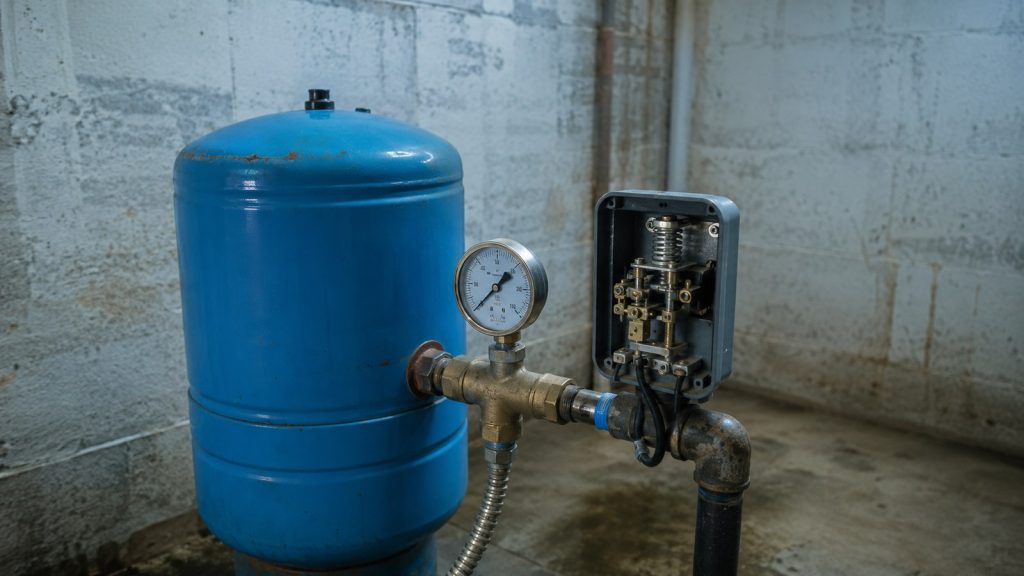
A standard residential system cuts the pump in at about 20 psi and out at about 40 psi, or 30 and 50 on higher-pressure settings. Between the well and your tap sit a breaker, a pressure switch, a pressure tank, a check valve and a length of wire. Every one of those fails more often than the pump, and every one of them produces symptoms that look like pump failure from the kitchen.
The single most useful gauge in the house is the pressure gauge on the tank. Watching what it does while a tap runs separates most of these causes in under two minutes.
Symptom, Cause and Safe Check
| Symptom | Most likely causes, commonest first | Safe check you can do yourself | When it needs a professional |
|---|---|---|---|
| No water at all, pump silent | Tripped breaker, failed pressure switch, burned switch contacts, control box failure, motor failure | Check the breaker. Look at the tank gauge: if it reads below cut-in and the pump is not running, the switch or the supply is at fault, not the pump | Anything past the breaker. Opening a control box or switch cover exposes live 230V terminals |
| Pump runs constantly, pressure never builds | Dropping water level in the well, leak in the drop pipe, failed check valve, worn impellers, loss of prime on a jet pump | Listen for the pump running with no rise on the gauge. Check for obvious wet ground or a running fixture first | Yes, once a plumbing leak is ruled out. Diagnosing it means pulling the pump or testing the drop pipe |
| Pump switches on and off every few seconds | Waterlogged pressure tank, lost air charge, ruptured bladder | Tap the tank: a full dull sound top to bottom means it has lost its air cushion. Check the air valve pressure with the system depressurized | Only if recharging the air does not fix it, which points to a ruptured bladder and tank replacement |
| Air spitting from taps | Water level dropping to the pump intake, a leak drawing air into the suction side, gas naturally present in the aquifer | Note whether it happens after heavy use and recovers overnight, which suggests a yield problem rather than a fault | Yes, if it persists. Continued air ingestion damages the pump |
| Pressure drops when two fixtures run | Undersized tank, partially closed valve, clogged sediment filter, scaled pipe, failing pump | Change or bypass the sediment filter, which is the commonest and cheapest cause | Only after the filter and valves are ruled out |
| Water is suddenly cloudy, sandy or gritty | Pump drawing near the bottom, failing well screen, collapsing borehole | Stop using the water for drinking and note whether it clears. Sand damages the pump and every appliance downstream | Yes. Sand is a well construction issue, not a plumbing one |
| Breaker trips whenever the pump starts | Motor drawing locked-rotor current, damaged wiring, water in a splice, failing capacitor or control box | Reset once. If it trips again, stop | Yes, immediately. Repeated resets on a shorted motor circuit are a fire and shock risk |
| Pressure gauge reads high but flow is weak | Clogged filter, scaled or restricted pipe, partially closed valve, failing pressure-reducing valve | Compare flow at an outdoor spigot upstream of any filtration against an indoor tap | Only if the restriction is not in filtration or valves |
| Pump short cycles only under light use | Tank air charge slightly low, switch differential set too narrow | Check the air charge with the system depressurized | Adjusting switch differential is a live-terminal task and belongs to a professional |
| Water quality changed after pump work | System opened to the surface during the repair | None. This is a testing question rather than a mechanical one | Not mechanical, but retest for coliform bacteria before drinking |
Residential well pumps commonly run on 230 volts, and control boxes for submersible pumps contain capacitors that hold a charge after the power is switched off. Do not open a control box, a pressure switch cover or a wiring splice. Do not enter a well pit, which is a confined space that accumulates gas. Do not attempt to pull a submersible pump without proper equipment, because the assembly is heavy, the drop pipe is under load, and dropping it into the borehole turns a pump replacement into a well replacement.
The Three Checks Worth Doing First
- The breaker, once. Find the double-pole breaker for the well and check whether it has tripped. Reset it a single time. If it trips again, stop and call a professional, because a breaker that trips repeatedly is reporting a fault rather than being inconvenient.
- The pressure gauge, while a tap runs. Open a tap and watch. Pressure falling to the cut-in point with no pump start points at the switch or the power supply. Pump running with pressure not rising points at the well, the drop pipe or the pump. Pressure cycling rapidly between cut-in and cut-out points at the tank.
- The tank air charge, with the system depressurized. Switch off the pump breaker, open a tap to drain the pressure to zero, then check the air valve on top of the tank with an ordinary tire gauge. It should read about 2 psi below the cut-in pressure, so roughly 18 psi on a 20/40 system. Add air if it is low. If water comes out of the air valve, the bladder has ruptured and the tank needs replacing.
Waterlogging happens when the separation between air and water inside the tank fails and the water absorbs the air cushion. Without that cushion the pump starts and stops on a very small volume of water, which is why short cycling is the symptom most strongly associated with tank failure rather than pump failure.
Source: National Ground Water Association, Wellowner.org water well maintenance guidance
What Is Almost Never the Pump
Two symptoms send a disproportionate number of working pumps to the scrapyard. Rapid cycling is a pressure tank symptom in the overwhelming majority of cases, and replacing a pump because of it means the new pump inherits the same destructive cycling. Weak flow at one fixture is a fixture, filter or valve problem: a pump that can pressurize the system to cut-out is producing enough pressure by definition, so a single weak tap is downstream of it.
Which pump type a well actually has in the first place changes which symptoms even apply. Our submersible vs jet well pump comparison covers how the two designs fail differently.
A third is worth naming because it is seasonal. Air spitting and pressure loss that appear during a dry summer and recover after rain usually mean the water level in the well is dropping to the pump intake, not that the pump is failing. That is a yield problem, and replacing the pump does not add water to the aquifer.
Air spitting from the tap has more than one cause worth ruling out before assuming pump failure. Our how to prime a well pump guide covers the mechanical version of the same symptom.
If the pump runs, builds pressure and shuts off at cut-out, the pump is working. Diagnose everything else in the system before spending money on the most expensive part of it.
When It Really Is the Pump
Genuine pump failure looks like one of three patterns. The motor is dead: the breaker holds, the switch contacts are closing, and nothing runs. The pump runs but moves no water: motor turning, no pressure rise, with plumbing leaks and a dropped water level ruled out. Or the pump runs but delivers far less than it used to, which is worn impellers or an abrasion-damaged pump, usually in a well producing sand.
Once the pump itself is confirmed as the fault, the next question is whether the job is realistic to do without a contractor. Our how to replace a well pump guide covers the DIY-versus-pro line by pump type.
Age supports the diagnosis rather than making it. Submersible pumps commonly last well over a decade, so a fifteen-year-old pump with one of the three patterns above is a straightforward replacement decision, while a three-year-old pump with the same symptoms means something in the system is destroying pumps and needs finding first. Our wells and pumps guides cover the individual components in detail, and the contaminants reference explains which tests to run after any work that opens the system.
Once the pump is confirmed as the actual problem, budgeting for the replacement is the next step. Our well pump replacement cost guide breaks down real pricing by pump type and well depth.
Photograph the pump nameplate, the control box label and the pressure switch before calling a contractor. Horsepower, voltage, model and switch settings let the contractor arrive with the right parts, which frequently turns two visits into one.
Test the Water After the Repair
Any repair that opens the well, the casing or the pipework gives surface bacteria a route in. Contractors normally disinfect after pump work, but disinfection is not verification. Retest for coliform bacteria after the system has been flushed and any chlorine has cleared, and treat the result as part of the repair rather than an optional extra.
Frequently Asked Questions (FAQs)
What are the first signs a well pump is failing?
Loss of pressure under normal use, air spitting from taps, water that turns sandy or cloudy, a pump that runs without building pressure, and a rising electricity bill from a pump running longer than it used to. Rapid on-off cycling is usually the pressure tank rather than the pump.
Why does my well pump turn on and off every few seconds?
Almost always a pressure tank that has lost its air charge or has a ruptured bladder. Without an air cushion the tank holds very little usable water, so the pump satisfies demand and stops within seconds. It is a cheap fix, and leaving it in place shortens the life of the pump.
Can I check my own well pump safely?
You can check the breaker, read the pressure gauge, change a sediment filter and check the tank air charge with the system depressurized. You should not open a control box, a pressure switch cover or any wiring, because those carry 230 volts and control boxes store a charge after the power is off.
How long should a well pump last?
Submersible pumps commonly run for well over a decade in normal conditions. Sand, frequent cycling, oversized pumps in low-yield wells and voltage problems all shorten that considerably, which is why a young pump that fails is a signal to investigate the system rather than simply fit another one.
Should I test my water after a pump replacement?
Yes. Replacing a pump opens the well to the surface, so retest for coliform bacteria once the system has been flushed and any disinfectant has cleared. Contractors disinfect as a matter of routine, but only a test confirms the result.
- National Ground Water Association, Wellowner.org, water well maintenance, warning signs and guidance on when to involve a water well systems professional.
- Wellowner.org, pressure switch operation and typical cut-in and cut-out behavior.
- CDC, Drinking Water Safety, on testing after work that opens a well system.
- Minnesota Department of Health, Well Owner’s Handbook, private well system components and maintenance.



