Updated 30 September 2026
One grain per gallon equals 17.1 mg/L of hardness as calcium carbonate, so dividing a laboratory result in mg/L by 17.1 gives grains per gallon. The USGS calls water above 180 mg/L very hard, which is about 10.5 grains per gallon, and softening is commonly considered from around 7 grains per gallon upward.
Divide a hardness result in milligrams per liter by 17.1 to get grains per gallon, so the USGS very hard line of 180 mg/L is about 10.5 grains per gallon. Water hardness is reported in at least three different units, and the one your laboratory uses is rarely the one your softener dealer quotes. A laboratory report in milligrams per liter, a dealer talking in grains per gallon and a European appliance manual in millimoles per liter are all describing the same water, and the arithmetic between them is simple once you know the factors.
The classification is less simple, because two scales are in common use and they disagree about what counts as hard. The United States Geological Survey classifies water in milligrams per liter, while extension services such as Penn State publish a scale in grains per gallon. This tool converts between the units and reports both classifications, so a result can be read against whichever scale a given source is using.
Water Hardness Converter and Classifier
The Conversion, and Why Two Units Exist
Hardness is the concentration of dissolved calcium and magnesium, expressed by convention as though all of it were calcium carbonate. That convention is why almost every report says “as CaCO3” after the number.
Laboratories report in milligrams per liter because that is the unit their instruments produce and the unit every other analyte on the report uses. The water treatment industry reports in grains per gallon because softener capacity is sold in grains, and sizing a softener means multiplying grains per gallon by gallons per day. Neither unit is more correct. They serve different steps of the same process.
The factor between them is 17.1. A grain is an old unit of mass equal to about 64.8 milligrams, and a US gallon is about 3.785 liters, so one grain dissolved in one gallon works out to roughly 17.1 milligrams per liter. Penn State Extension states the same relationship in round terms, describing a grain per gallon as equal to approximately 17 mg/L.
Millimoles per liter appears on European appliance manuals and some scientific reports. One millimole of calcium carbonate per liter is 100.09 mg/L, because that is the molar mass of calcium carbonate.
The USGS classification is stated in milligrams per liter as calcium carbonate: 0 to 60 soft, 61 to 120 moderately hard, 121 to 180 hard, and more than 180 very hard.
Source: USGS Water Science School, Hardness of Water. Grains scale from Penn State Extension, Water Softening.
The Two Classification Scales
The scales are not contradictory, but they are drawn at different points, and a result near a boundary can be described differently depending on which one a writer used.
| Class | USGS scale (mg/L as CaCO3) | Extension scale (grains per gallon) | What it means in practice |
|---|---|---|---|
| Soft | 0 to 60 | Under 1.0 | Soap lathers easily, no scale. Very soft water is often slightly corrosive to plumbing |
| Slightly hard | Not a USGS band | 1.0 to 3.5 | No practical problems for most households |
| Moderately hard | 61 to 120 | 3.5 to 7.0 | Faint scale over time in kettles and heaters. Softening is a preference rather than a need |
| Hard | 121 to 180 | 7.0 to 10.5 | Visible scale, more soap and detergent used, shortened water heater life |
| Very hard | Above 180 | Above 10.5 | Persistent scale on fixtures and appliances. Softening is usually worth the running cost |
What Each Band Actually Costs You
Hardness has no federal drinking water limit of any kind, primary or secondary, because it is not a health contaminant. The case for treating it is economic and practical rather than medical.
Scale forms when hard water is heated, which is why the damage concentrates in water heaters, kettles, dishwashers and coffee machines rather than in cold pipework. Deposits on a heating element insulate it, so the element runs hotter and longer to deliver the same hot water. Soap and detergent also work less effectively in hard water, so households at the hard end use measurably more of both.
Against that sits the running cost of a softener: salt, the water used in each regeneration, and the maintenance. Somewhere around 7 grains per gallon the arithmetic usually starts to favor treating, and above 10.5 it clearly does. Below about 3.5 grains per gallon a softener is rarely worth its own running cost.
Once you have the number, the practical question is whether your household has a hardness problem worth solving. Our is well water hard water guide covers what counts as hard for a private well and what happens if it goes untreated.
A result of 171 mg/L converts to 10 grains per gallon. The USGS calls that hard, the extension grains scale calls it hard, and it sits just below the point where softening is close to automatic. That is a household where a softener is a reasonable purchase but not an urgent one.
Where Hardness Is Not the Problem
Two complaints get blamed on hardness and are usually something else. Orange or brown staining is iron, not hardness, and a softener sized without accounting for it will foul. Black staining is manganese. Both are separate analytes with their own aesthetic guidelines, and both are commonly present in the same well water as hardness, which is why they get confused.
A rotten egg smell is hydrogen sulfide or sulfur bacteria, and no softener addresses it. Cloudy water that clears from the bottom of the glass upward is dissolved air, which is harmless and unrelated to hardness. Our well water contaminants reference separates these out with the limit that applies to each.
Ask for hardness and dissolved iron on the same report. The two numbers together are what a softener is sized from, and ordering them separately usually costs more than ordering them at once.
Using the Number to Size Equipment
Converting hardness is the first step. Sizing a softener from it needs household size, target regeneration interval and any dissolved iron, and our water softener sizing calculator takes the converted figure and works through that arithmetic with the same published method.
Once the softener itself is sized, pricing the purchase and install is the next step. Our water softener cost guide breaks down unit, installation, and salt cost over time.
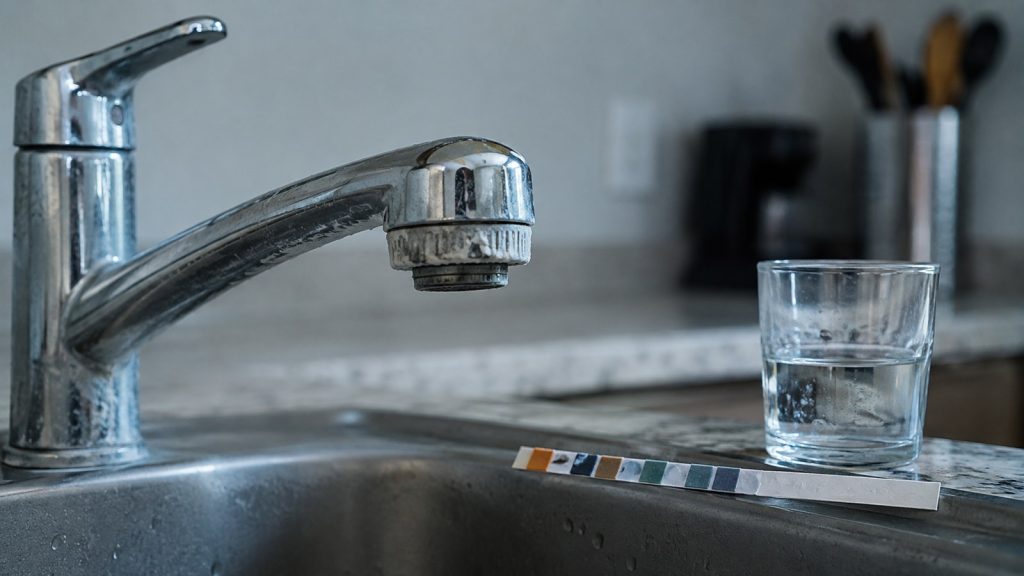
One caution about test sources. Hardness strips and dealer test kits are quick and adequate for confirming that a softener is still working, but a strip reading is not the number to buy equipment from. A laboratory hardness test is one of the cheapest single analytes available, and a softener sized from a guess stays wrong for its entire service life.
Once the number is confirmed, comparing actual softener models built for well water is the next step. Our best water softeners for well water roundup rates seven units on capacity and iron handling.
Frequently Asked Questions (FAQs)
How do I convert mg/L hardness to grains per gallon?
Divide by 17.1. A result of 171 mg/L as calcium carbonate is 10 grains per gallon. Going the other way, multiply grains per gallon by 17.1 to get milligrams per liter.
What hardness level is considered hard water?
The USGS calls water hard from 121 to 180 mg/L as calcium carbonate and very hard above 180. On the grains scale used by extension services that is 7.0 to 10.5 grains per gallon for hard, and above 10.5 for very hard.
At what hardness should I install a water softener?
There is no regulatory answer, because hardness is not a health contaminant and has no federal limit. In practice the running cost of a softener starts to be repaid by reduced scale, detergent and appliance wear somewhere around 7 grains per gallon, and clearly so above 10.5.
Is hard water bad for your health?
No. Hardness is dissolved calcium and magnesium, and it carries no federal drinking water limit of any kind. The problems it causes are scale, soap efficiency and appliance life, which are practical and financial rather than medical.
Why does my report say hardness as CaCO3?
Because hardness is a combined measure of calcium and magnesium, and expressing both as though they were calcium carbonate gives a single comparable number. Every common hardness unit uses that same convention, which is what makes the conversions straightforward.
- USGS Water Science School, Hardness of Water, classification in mg/L as calcium carbonate.
- Penn State Extension, Water Softening, grains per gallon conversion and the grains classification scale.
- EPA, Secondary Drinking Water Standards, confirming that hardness carries no federal limit while iron and manganese have aesthetic guidelines.



