Updated 30 September 2026
Test private well water for total coliform bacteria and nitrate every year at minimum, and add a broader panel (arsenic, iron, manganese, hardness, pH) every three to five years or whenever water quality changes. Use a state-certified lab, not a big-box test strip, for any result you plan to act on.
More than 43 million Americans, close to 15 percent of the country, draw drinking water from a private well, and the Environmental Protection Agency does not regulate a single one of them. Well water testing is not a government requirement. It is the only way a homeowner finds out what is actually coming out of the tap.
The Wisconsin Department of Natural Resources recommends testing for bacteria once a year, and testing for nitrate once a year as well, particularly before the well supplies a pregnant woman or one planning a pregnancy. Those two tests alone catch the contaminants most likely to make someone sick, and both come back from a lab in days.
Most well owners skip this until something changes, a smell, a stain, a new baby in the house, then scramble to figure out which test to order and where to send it. That scramble is avoidable. This guide covers what to test for, how often, what it costs, and the exact steps for pulling a sample a lab will actually accept.
What Well Water Testing Actually Covers
Well water testing means sending a sample to a certified laboratory that measures specific contaminants against health and aesthetic thresholds. A basic panel checks total coliform bacteria and E. coli, since these indicate whether surface contamination has reached the well. An expanded panel adds nitrate, arsenic, lead, iron, manganese, hardness, pH, and total dissolved solids.
This guide sits in our Water Testing section alongside the kits versus certified labs comparison and the guide to reading a finished lab report line by line.
Which contaminants matter depends on your region. Arsenic is a bigger concern in parts of New England and the upper Midwest. Nitrate tracks with agricultural land use nearby. A local health department or extension office can tell you what shows up most often in wells near yours, which narrows an otherwise long list of options.
How frequently each of those tests belongs on the calendar is its own question. Our how often to test well water guide covers the annual baseline and the events that call for an immediate retest.
Two contaminants a routine panel does not catch are PFAS, the “forever chemicals,” and radon gas. Neither shows up in a standard bacteria, nitrate, or metals test, and neither has a smell, taste, or color to warn you. A well near an industrial site, an airport, or a military installation, or one in a known high-radon region, is a candidate for ordering those tests separately rather than assuming the standard panel already covers them.
How to Read a Well Water Test Report
A lab report lists each contaminant, the measured amount, and a comparison figure: the EPA health threshold for a regulated public system, even though that threshold does not legally apply to your well. Anything reported above that comparison figure deserves attention regardless of whether the report calls it a violation.
Bacteria results usually come back as simply present or absent, since any detectable coliform bacteria signals a pathway into the well that needs to be addressed. Chemical results like nitrate, arsenic, and iron come back as a number, which matters because a level just above threshold calls for different action than a level several times over it.
Test Kits vs. Certified Labs
Home test strips give a fast read on pH, hardness, or chlorine, and they work fine for a rough check between full tests. They are not reliable for bacteria or for anything with a legal health threshold, since strip color-matching is imprecise and easy to misread.
For the full comparison between a strip and a certified lab, including when each one is the right call, see our how to test well water guide.
A certified laboratory result is what a home inspector, a lender, or a health department will accept, and it is the only version of “my water tested clean” that means anything if a problem shows up later. Order a test kit directly from a state-certified lab; most mail a sterile bottle, instructions, and a prepaid return label.
What that lab visit actually costs varies by package. Our well water testing cost guide lists real prices from accredited labs so the number is not a guess before you order a kit.
For what each result means once it arrives, our contaminants reference gives the federal limit for every common well water contaminant and labels whether it is an enforceable health limit or an aesthetic guideline.
Wisconsin’s DNR advises stopping use of the water immediately if a lab report shows bacteria present, and treating any nitrate result above 10 parts per million as a signal to stop giving the water to infants and switch to a safe alternative.
How to Test Your Well Water
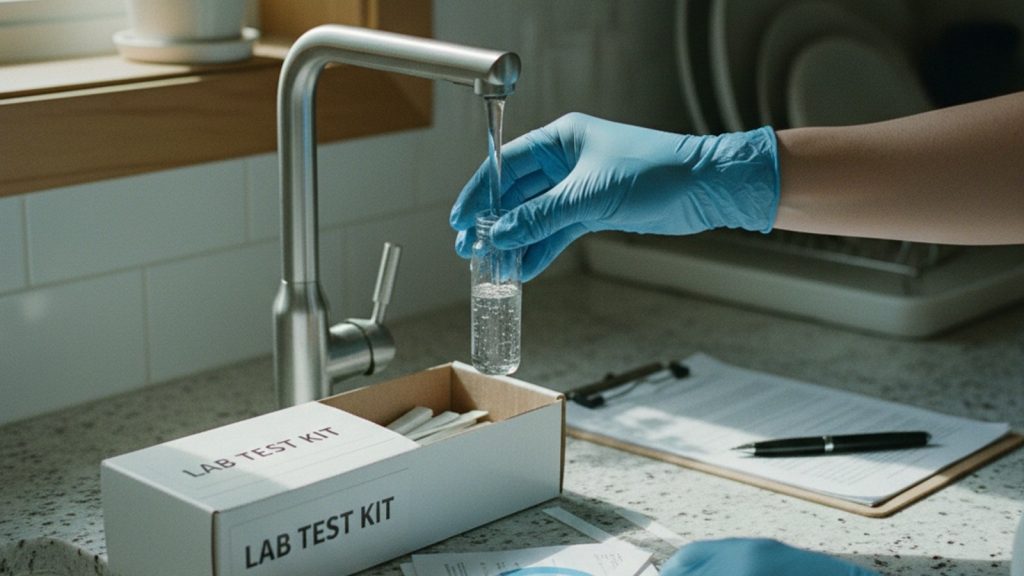
- Order the right kit. Contact a state-certified lab and request bottles matched to what you are testing: sterile bottles for bacteria, acid-preserved bottles for metals. Using the wrong bottle can void the result.
- Pick a cold-water tap close to the well. Choose an indoor tap ahead of any filter or softener, so the sample reflects raw well water rather than treated water.
- Remove the aerator and disinfect the tap. Take off any screen attachment, then wipe the faucet with rubbing alcohol or a diluted bleach solution to keep outside bacteria from contaminating the sample.
- Run the water before sampling. Let cold water run for two to five minutes to clear standing water from the pipe, unless your instructions specify a first-draw sample for a lead test.
- Fill the bottle without touching the inside. Fill to the marked line, cap it immediately, and avoid rinsing bottles that already contain a preservative.
- Label, chill, and ship the same day. Bacteria samples typically need to reach the lab within 24 to 30 hours, so same-day shipping or drop-off matters more for this test than any other.
The Challenges of Staying on a Testing Schedule
The biggest challenge is that private well water carries no reminder system. City water customers get an annual quality report in the mail. Well owners get nothing unless they schedule it themselves, so testing quietly lapses for years until a symptom forces the issue.
The second challenge is matching the panel to the risk. Testing for everything every year is expensive and mostly unnecessary; testing for nothing until symptoms appear misses invisible contaminants like arsenic and nitrate that carry real health risk with zero taste or smell warning.
The third challenge is timing after events. A flood, a nearby septic repair, or new construction near the well can all change water quality within days, and the annual test cycle will not catch that unless you test again right after the event.
Keep every lab report. A pattern across two or three years, iron creeping up, pH drifting, tells you more about a developing problem than any single result on its own.
| Test | What it finds | How often |
|---|---|---|
| Total coliform bacteria / E. coli | Surface or septic contamination reaching the well | Every year, and after any change in taste, color, or smell |
| Nitrate | Agricultural runoff, septic contamination | Every year, especially before an infant or pregnant household member drinks the water |
| Arsenic | Naturally occurring in bedrock in some regions | Every five years; every year in known high-arsenic counties |
| Iron and manganese | Staining, metallic taste, plumbing buildup | Every one to two years, or when stains appear |
| Hardness and pH | Scale buildup, pipe corrosion | Every one to two years, or before installing a softener |
| Full expanded panel | Metals, VOCs, and other regional contaminants | Every three to five years, or at home purchase |
If a test shows bacteria present, stop drinking the water right away and switch to bottled or another verified safe source until the well is shock chlorinated and a follow-up test comes back clean.
How to Build a Testing Schedule You’ll Actually Keep
Anchor the annual bacteria and nitrate test to a date you will not forget, a birthday, the start of spring, tax season, and put it on a recurring calendar reminder. Add the expanded panel every three to five years, or immediately after any flood, nearby construction, or new symptom.
Once results come back, the next decision is what to do about anything that fails. That is a filtration question, not a testing question, and it deserves its own comparison of equipment before you buy.
Once you have a baseline result, comparing it against treatment options in the well water filtration system guide tells you exactly what equipment addresses what your lab report found.
Frequently Asked Questions (FAQs)
How often should I test my well water?
Test for bacteria and nitrate every year at minimum. Add arsenic, iron, manganese, hardness, and a broader panel every three to five years, and retest sooner after a flood, nearby construction, or any change in taste, color, or smell.
What does well water testing cost?
Cost depends on the lab and the number of contaminants in the panel; a basic bacteria and nitrate test costs less than an expanded metals and chemical panel. Contact a state-certified lab directly for current pricing on the specific tests you need.
Can I test my well water myself?
You can collect the sample yourself following the lab’s instructions, but the analysis itself needs to happen at a certified laboratory. Store-bought test strips give a rough read on things like pH or hardness but are not reliable for bacteria or health-based contaminants.
Can standard well water tests detect PFAS or radon?
No. A routine coliform, nitrate, or metals panel does not include PFAS or radon gas. Both require a specialized test ordered separately from a certified lab, and neither contaminant gives any warning sign in taste, smell, or color.
Do I need to test well water after buying a house?
Yes. Order a full expanded panel before or immediately after closing, even if the seller provided a recent report. Water quality can change between the seller’s test date and your move-in date, and a fresh baseline protects you either way.



